
Is California’s Minimum Auto Insurance Really Enough? Probably Not.
You’re a careful driver. You follow the rules. You just need to check that box for the DMV, right? Many people think getting the absolute cheapest auto insurance in California means choosing the minimum liability coverage. And yes, legally, that’s true. The state requires what’s often called “15/30/5” coverage.
What Exactly Does “15/30/5” Mean?
It sounds like a secret code, but it’s pretty simple. It breaks down like this:
- $15,000 for bodily injury liability per person: If you cause an accident, your insurance will pay up to $15,000 for injuries to one person in the other car.
- $30,000 for bodily injury liability per accident: No matter how many people are hurt, your insurance will pay a maximum of $30,000 for all their injuries combined.
- $5,000 for property damage liability per accident: This covers damage to the other person’s car or property — like a fence or a lamppost.
That’s it. That’s the baseline. You get this, and you’re technically legal to drive on California roads. But here’s the thing: “legal” and “protected” are two totally different ideas.

Myth: Minimum Coverage Will Protect My Finances After an Accident.
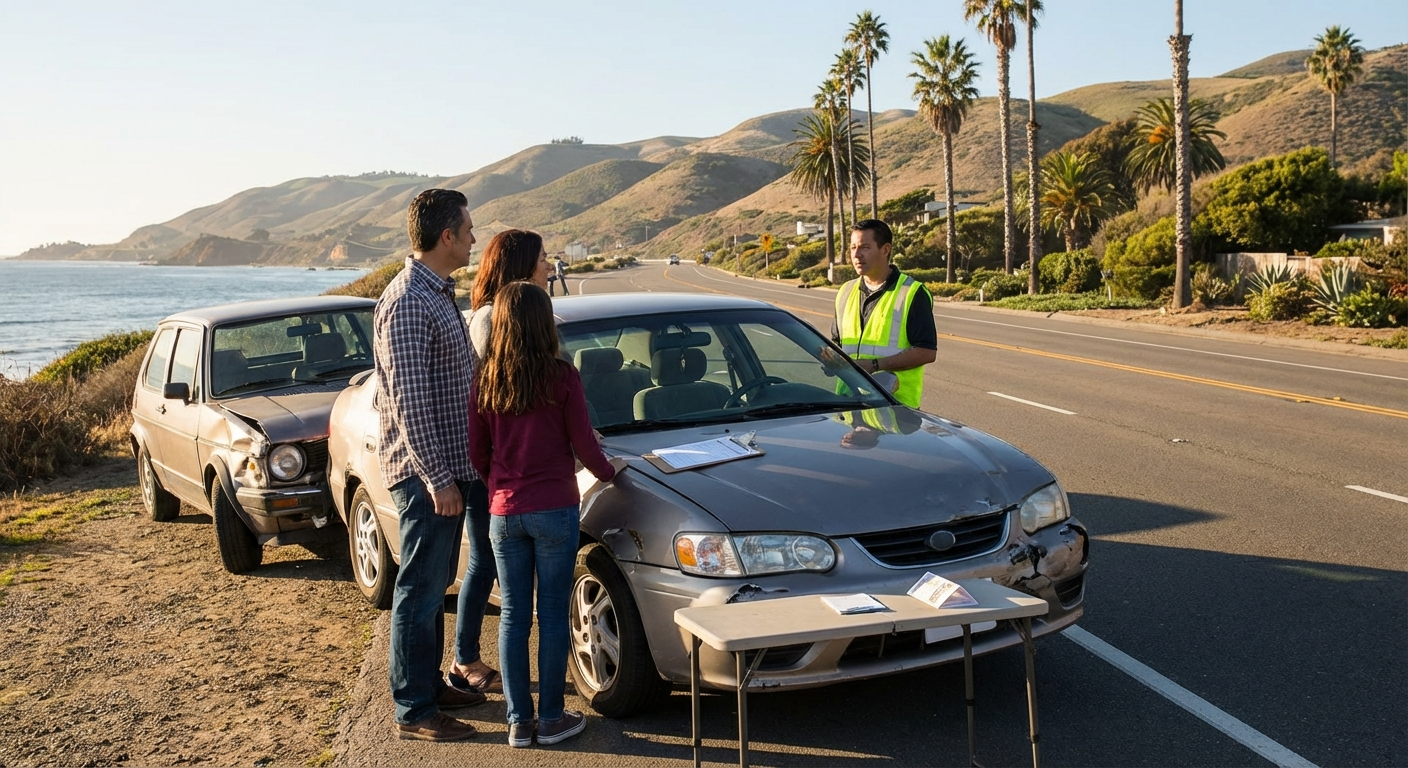
Honestly? It almost certainly won’t. Imagine you’re driving through a busy intersection in the Valley, maybe near Studio City. Someone cuts you off, you swerve, and you clip the back of a brand-new Mercedes-Benz. The driver gets whiplash, and their passenger breaks an arm. Now, consider the costs:
- A new Mercedes bumper? Easily $3,000-$5,000.
- Medical bills for a broken arm? Could be $10,000-$20,000, even more.
- Whiplash treatment, physical therapy, lost wages? Another $5,000-$15,000.
Suddenly, you’ve got $30,000 or more in damages and injuries. Your minimum $15,000 per person and $30,000 per accident for injuries, plus $5,000 for property damage, just won’t cut it. That’s a huge gap. Who pays the rest? You do. Out of your own pocket. We’re talking about potential wage garnishments, liens on your property, or even bankruptcy. It’s a scary thought, but it’s a real risk many people don’t consider when they opt for the bare minimum.
Myth: The State Has a Good Low-Cost Program for Everyone.
California does have a Low-Cost Auto Insurance Program. It’s a fantastic initiative for those who qualify, designed to help low-income drivers get affordable coverage. But it’s not for everyone. To qualify, you usually need to meet strict income requirements, have a vehicle valued under $25,000, and maintain a good driving record. It’s a targeted solution, not a universal safety net. Many drivers who think they might qualify actually don’t, leaving them to navigate the standard — and often pricier — insurance market.
What About My Own Car? Or My Own Medical Bills?
That’s not the whole story. The “15/30/5” minimum only covers the *other* person’s damages and injuries if you’re at fault. What if your car gets totaled? What if *you* get hurt? Minimum liability coverage won’t pay a dime for your own car repairs or your medical expenses. Not one cent.
This is where other types of coverage come in, and they’re worth considering for most drivers.
- Collision Coverage: Pays to repair or replace your car if you hit another car or object, regardless of who’s at fault.
- Comprehensive Coverage: Covers damage to your car from things like theft, vandalism, fire (a real concern with those wildfire seasons in Ventura County), hail, or hitting an animal.
- Medical Payments (MedPay): Pays for your — and your passengers’ — medical bills, up to a certain limit, no matter who caused the accident. This can be a lifesaver for small injuries or to cover deductibles on your health insurance.
Which brings up something most people miss: Uninsured Motorist Coverage.
Here in California, it’s a huge deal. Despite the legal requirement, an unsettling number of drivers are on the road without insurance. Some estimates suggest it could be as high as 15-20% in some parts of the state, like the Inland Empire. If one of *those* drivers hits you, and they don’t have insurance (or enough insurance), who pays for your medical bills and car repairs?
That’s where Uninsured/Underinsured Motorist (UM/UIM) coverage steps in. It’s designed to protect you in exactly those situations. It’s often offered in similar limits to your liability coverage — say, 15/30 for bodily injury. If you can afford it, increasing those UM/UIM limits is often one of the smartest moves you can make. It’s your personal shield against someone else’s irresponsibility.
Why Are Premiums Climbing So High in California?
It’s not just your imagination. Many California drivers have seen their premiums jump significantly. Some policies have climbed 20-30% in just a couple of years, between 2022 and 2024. Why? A few reasons are at play.
First, inflation. Everything costs more now. Car parts are pricier, labor rates for mechanics are up, and medical costs continue their upward march. Second, our state faces increasing risks. Think about the severe weather patterns — the floods and mudslides, the ever-present threat of wildfires, like the concern around future LA fires. These events put pressure on insurers. Third, some major insurers, like State Farm, AAA, and Farmers, have been adjusting their strategies in California, sometimes limiting new policies or raising rates to offset their own rising costs and risks. It’s a challenging market for everyone.
So, while minimum coverage might seem like a way to save money, it’s often a false economy in the face of these rising costs and risks. A serious accident could wipe out any savings and then some.
Ready to Talk About Real Protection?
It can feel overwhelming, trying to figure out what’s truly enough without breaking the bank. That’s where an experienced insurance professional comes in. Someone like Karl Susman at Los Angeles Auto Insurance Quotes knows the California market inside and out. He understands the unique risks of driving in places like Los Angeles, from the crowded freeways to the quiet suburban streets. He’s helped countless drivers find the right balance between cost and actual protection.
You don’t have to guess. You don’t have to settle for just “legal.” You deserve to feel confident that if something goes wrong, you’re not left holding the bag for tens of thousands of dollars.
Ready for a real conversation about your auto insurance? Get a personalized quote and see what proper coverage looks like for you. Karl Susman, CA License #OB75129, and his team are ready to help. Click here to get a quote today!
It’s About Your Peace of Mind, Not Just a Policy Number.
Think about your assets. Think about your future. If you own a home, have savings, or even just rely on your income, minimum coverage leaves you incredibly vulnerable. It’s a calculated risk, but for most people, the potential downside is far too great.
Getting the right auto insurance isn’t about spending the most money; it’s about spending it wisely. It’s about protecting what you’ve worked for and ensuring a single moment of bad luck on the road doesn’t derail your entire life. Don’t let a low premium today lead to financial catastrophe tomorrow.
Frequently Asked Questions About California Auto Insurance
Q: Is there a “good driver” discount in California?
A: Yes! Thanks to Proposition 103, insurers in California must offer at least a 20% discount to “good drivers.” Generally, this means you’ve had a valid driver’s license for at least three years, haven’t had more than one minor traffic violation, and haven’t been at fault in an accident resulting in bodily injury or death during the past three years. It’s a nice perk for safe drivers.
Q: What happens if I get caught driving without insurance in California?
A: It’s not pretty. You could face fines, your vehicle might be impounded, and your driver’s license could be suspended. Plus, if you cause an accident without insurance, you’re on the hook for all damages and injuries out of your own pocket. The penalties and financial risks are substantial.
Q: Should I get higher liability limits than the minimum?
A: For most drivers, absolutely. The minimum 15/30/5 limits are very low given today’s medical and vehicle repair costs. Many experts recommend at least 100/300/50 ($100,000 per person, $300,000 per accident for bodily injury, and $50,000 for property damage) or even higher, especially if you have significant assets to protect. The cost difference between minimum and higher limits is often less than you’d think, but the protection difference is massive.
Q: Can my credit score affect my auto insurance rates in California?
A: No. Unlike many other states, California law (specifically Proposition 103) prohibits insurance companies from using your credit score as a factor in determining your auto insurance premiums. Insurers can only use factors like your driving record, miles driven, years of driving experience, and location.
Q: How often should I review my auto insurance policy?
A: You should review your policy at least once a year, or whenever significant life changes happen. Did you buy a new car? Get married? Move to a new area like out to Riverside or down to San Diego? Add a new driver to your household? Any of these can affect your coverage needs and rates. It’s a good idea to chat with an agent like Karl Susman to make sure your policy still fits your life.
Ready to get the right coverage for your California driving? Don’t wait until it’s too late. Get a free, no-obligation quote today!
This article is for informational purposes only and does not constitute financial advice.